A Practical Guide to the Double Diamond Design Process for B2B SaaS Teams
A step-by-step explanation of the Double Diamond framework, showing how B2B SaaS teams move from problem discovery to validated solutions.


Table of Contents
Title
Title
Title
The Double Diamond is less of a rigid process and more of a mental map. It guides product teams from the messy, uncertain beginning of a problem all the way to a clear, tested solution.
At its core, the framework follows a simple rhythm: explore broadly, then focus deliberately. This cycle happens twice: first to identify the right problem, and then to design the right solution.
What Is the Double Diamond Design Process?
Think of it like a good detective working a case. Before zeroing in on a suspect, they spend time at the crime scene, casting a wide net for clues and talking to everyone involved. That's the exploration phase, or divergent thinking. Only after gathering all the facts do they start connecting the dots, ruling out dead ends, and focusing on the most likely culprit. That's the convergent part.
The Double Diamond brings that same disciplined thinking to product design. It gives B2B SaaS teams a structured way to innovate, stopping them from prematurely jumping to a solution based on a hunch. It forces you to first get a deep understanding of the user and their world before you ever start brainstorming features.
This structured approach is a cornerstone of modern product design.
The Two Diamonds and Four Phases
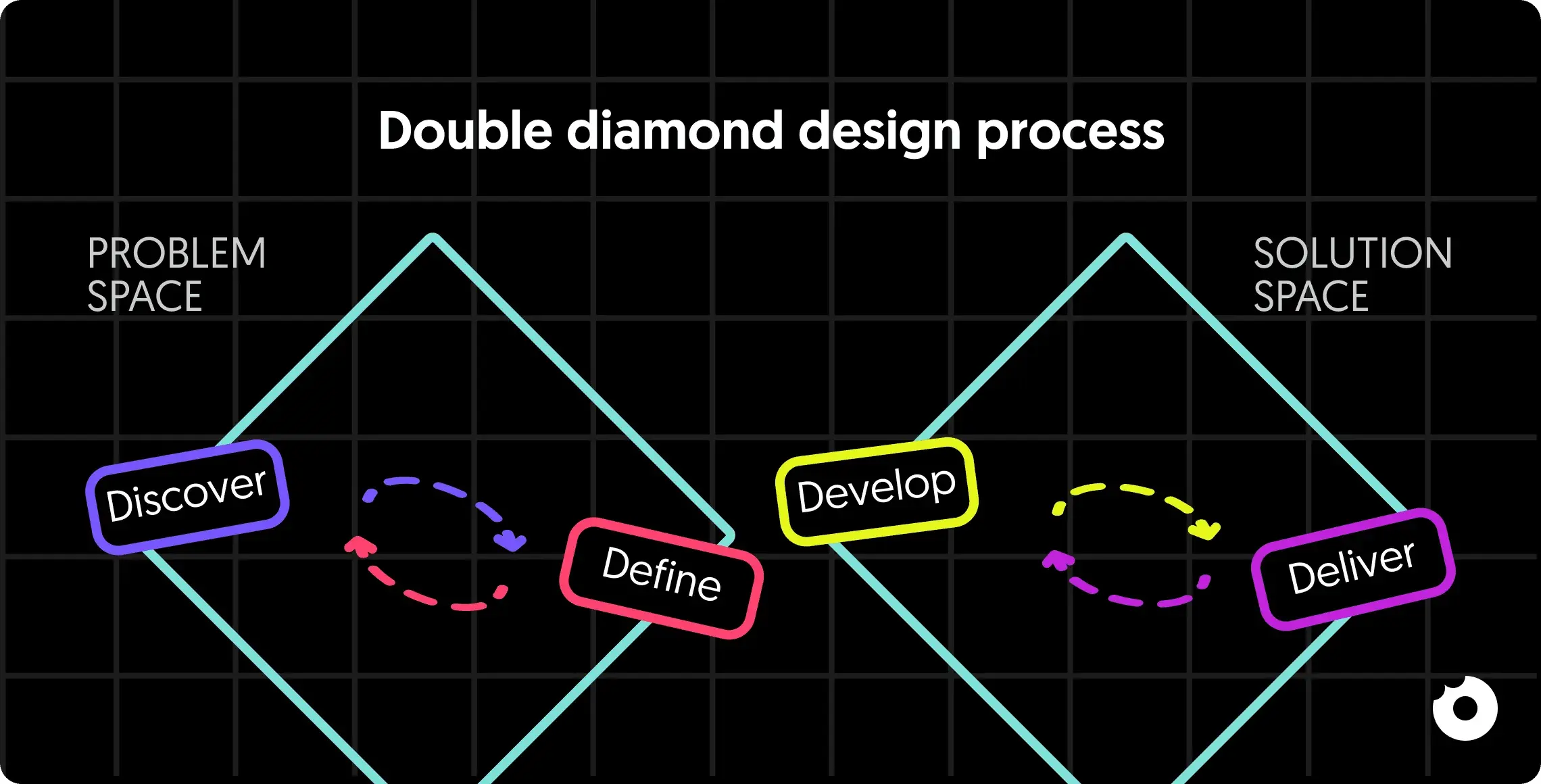
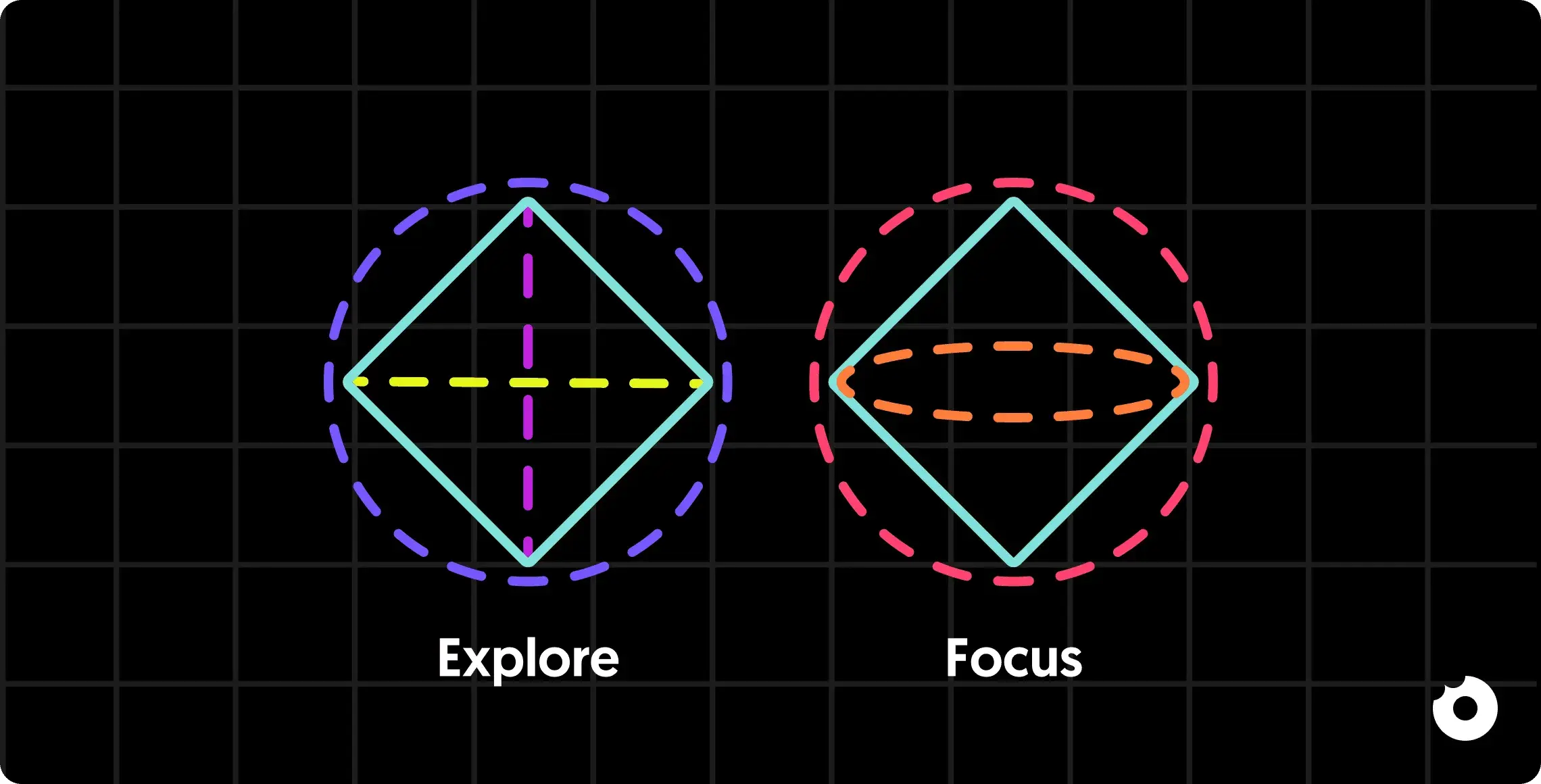
The name comes from its shape: two diamonds placed side-by-side. Each diamond represents one cycle of exploring and then focusing.
The First Diamond (The Problem Space): This is all about research and strategy. The entire goal here is to find and validate the real problem. You start by exploring broadly (Discover) and finish by homing in on a crystal-clear problem statement (Define).
The Second Diamond (The Solution Space): This is where design and development kick in. You’re now focused on crafting the best possible answer to the problem you just defined. It starts with ideation and prototyping (Develop) and ends with a tested, polished solution ready for the real world (Deliver).
This flow provides a clear path from total ambiguity to confident clarity.
To make this even clearer, here’s a quick breakdown of what each phase is about.
The Four Phases of the Double Diamond Process
Phase | Thinking Style | Primary Goal |
|---|---|---|
Discover | Divergent | To understand the user and the problem space without bias. |
Define | Convergent | To synthesise research into a clear, actionable problem statement. |
Develop | Divergent | To explore, brainstorm, and prototype a wide range of potential solutions. |
Deliver | Convergent | To test, refine, and finalise the best solution for launch. |
This simple structure helps teams stay aligned and ensures that no critical step gets skipped on the way to building a great product.
A Proven Framework for Innovation
The Double Diamond isn't some new, untested trend. It was first popularised by the UK's Design Council way back in 2004 and has since become a standard in product development.
It has proven particularly effective in complex B2B sectors like business intelligence (BI). For instance, one 2023 study found that 68% of BI product teams in the UK and Europe now actively use its principles. That’s a huge leap from just 32% back in 2018, showing just how valuable this "explore-then-focus" mindset really is.
Getting to the Heart of the Real Problem
The journey into the Double Diamond design process doesn't start with brilliant ideas or flashy solutions. It starts with a deep, deliberate dive into the problem itself. This first diamond is all about making sure you’re solving the right problem, a step that often separates a product people love from one they ignore.
Too many teams get this wrong. They rush past the problem and build on shaky assumptions, only to end up with a perfectly engineered solution to an issue nobody actually has. The first diamond forces you to slow down, listen, and truly understand your users before a single line of code gets written.
The Discover Phase: Going Wide with Research
The Discover phase is about exploration without assumptions. The goal isn’t to confirm ideas, but to ask better questions and challenge what the team thinks it already knows.
Think of the team as investigative journalists: the task is to uncover the real story, even if it contradicts expectations. This means stepping into the user’s world and understanding their reality firsthand.
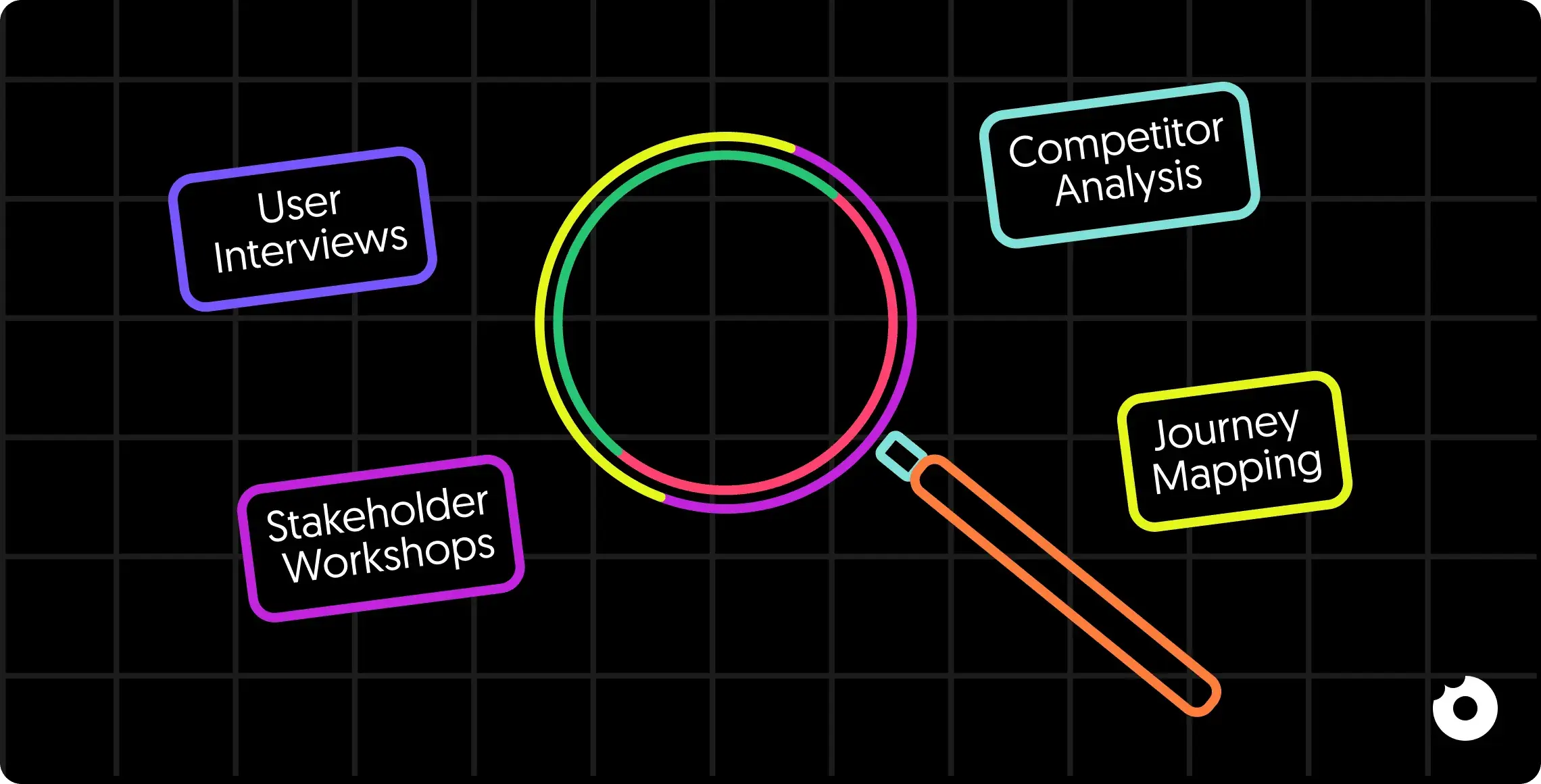
Common Activities in the Discover Phase
User Interviews: Real, one-on-one conversations to hear about users' motivations, frustrations, and daily routines in their own words.
Stakeholder Workshops: Getting everyone in the same room to align on business goals, technical limits, and what's already known.
Competitor Analysis: Taking a hard look at how other products are trying to solve similar problems, and where they're falling short.
Journey Mapping: Visualising a user's entire experience from start to finish to pinpoint the emotional highs and lows.
For B2B SaaS teams, this is non-negotiable. A FinTech team, for example, might assume their accounting users just want faster data entry. But after a few discovery interviews, they could find the real pain is a crippling anxiety around compliance regulations. That's a much more valuable and complex problem to solve. A solid discovery process is the bedrock of success; you can see more on the key steps in a product discovery engagement.
The Define Phase: Nailing Down the Core Problem
After the wide exploration of the Discover phase, the Define phase brings focus. This is where teams switch to convergent thinking, synthesising research, identifying patterns, and shaping one clear problem statement that will guide all future decisions.
This step is often the most challenging part of the first diamond. Messy, ambiguous insights have to be turned into clarity. The team moves from broad “what if” questions to a focused and actionable “how might we.”
The goal of Define isn’t to list every problem you’ve found, but to articulate the one problem that matters most, for both users and the business.
Done well, this focus pays off. Teams that follow the Double Diamond report higher launch success and lower development costs, largely because real user pain points are identified early and addressed deliberately.
Key Techniques for the Define Phase
Affinity Diagramming: Cluster research insights into themes to surface patterns.
“How Might We” Questions: Reframe insights into open, solution-friendly prompts.
The 5 Whys: Dig beneath surface issues to uncover root causes.
Problem Statement: A user-centred definition that’s focused, but flexible enough for creative solutions.
By the end of the Define phase, the team leaves ambiguity behind and enters the second diamond with a sharp understanding of the real problem, a foundation that makes designing the right solution possible.
Designing the Right Solution
We’ve navigated the first diamond and zeroed in on the right problem to solve. Now, it's time to enter the second diamond: the solution space. This is where we take all those abstract insights and user needs and start shaping them into a real, tangible product. The entire focus shifts from understanding the problem to building the right solution for it.
This part of the double diamond design process is where the magic really happens. It's an exciting blend of creativity, teamwork, and sharp-eyed evaluation that brings a concept to life. We start by casting a wide net for potential solutions before carefully homing in on the very best one to build and launch.
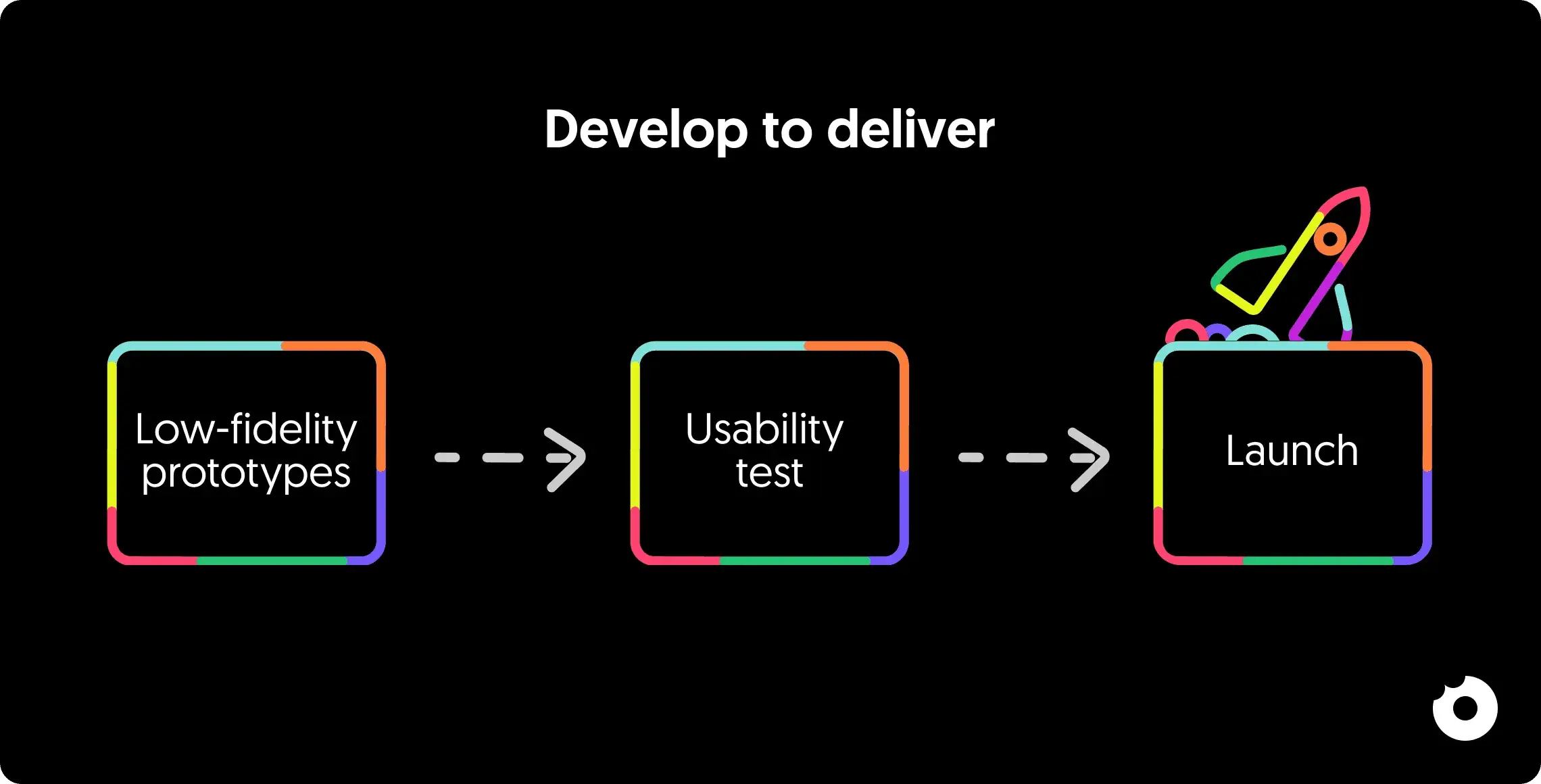
The Develop Phase: Exploring All Possibilities
The Develop phase opens the solution space. With a clear problem in mind, teams explore multiple directions, generate ideas, and prototype different ways forward, prioritising exploration over refinement.
Think of it like an architect sketching out initial ideas. Before they settle on a final blueprint, they'll draw dozens of concepts, some are practical, others are wonderfully out there. This exploration ensures they don't just grab the first, most obvious idea. In the world of B2B SaaS, this is crucial for avoiding the trap of getting locked into a single concept that's rarely the strongest one.
This phase is all about creating options and fostering a "yes, and..." culture. Every idea is put on the table, and judgement is put on hold. Creating that psychological safety is what allows the truly innovative approaches to surface.
Practical Ideation Methods for B2B SaaS
Structured Brainstorming: Techniques like Crazy 8s help teams generate ideas quickly and move past obvious solutions.
Storyboarding: Mapping the user journey makes key interactions and friction points visible early.
Rapid Prototyping: Low-fidelity wireframes in tools like Figma or Balsamiq help test concepts before investing in detail.
The goal isn’t a single polished design, but a small set of promising ideas ready for evaluation and testing.
The Deliver Phase: Refining the Final Product
The Deliver phase brings focus back in. The most promising solution is tested, refined, and prepared for development, ensuring it works in practice, not just in theory.
If Develop was about creating options, Deliver is about making confident decisions backed by real user data. The most promising prototypes get a major upgrade, evolving from rough sketches into high-fidelity, interactive models that look and feel just like the final product.
This is where the rubber meets the road. The goal is to rigorously test the chosen design with actual users to make sure it not only solves the problem but is also intuitive, efficient, and maybe even a little delightful to use.
The Deliver phase is the final quality gate. It’s where you prove your solution works not just in theory, but in the hands of the people who will use it every day. This step transforms a good idea into a great product experience.
This meticulous approach of developing and then delivering a tested solution has a massive impact. A 2024 review from Splunk on European IT sectors highlighted just how effective this framework is. They found that 73% of surveyed IT organisations saw 50% fewer post-launch issues after adopting it. To get the full story, you can read the complete analysis from Splunk.
Key Activities and Metrics for the Deliver Phase This final stage is all about structured validation and hitting clear checkpoints to ensure the solution is launch-ready.
High-Fidelity Prototyping: Designers craft detailed, interactive mockups in tools like Figma that are a spitting image of the final UI and UX. These are absolutely essential for running meaningful usability tests.
Usability Testing: This is the heart of the Deliver phase. We watch real users as they try to complete specific tasks with the high-fidelity prototype, gathering both hard data and priceless qualitative feedback on what’s working and what isn’t.
QA and Handoff Prep: Designers and engineers get in lockstep to make sure the final designs are technically feasible and well-documented. A smooth design handoff, often including a full component library or design system, is prepared to make the development process as seamless as possible.
Throughout this process, the team keeps a close eye on key performance indicators (KPIs) to measure success without any guesswork.
Metric | What It Measures | Why It's Important in B2B SaaS |
|---|---|---|
Task Completion Rate | The percentage of users who successfully complete a given task. | This tells you if the solution actually works for the complex workflows your users have. |
System Usability Scale (SUS) | A standard questionnaire to get a user's subjective rating of usability. | It provides a reliable score for overall user satisfaction and ease of use. |
Time on Task | The average time it takes a user to complete a task. | This is a direct measure of efficiency, a must-have for productivity-focused software. |
Error Rate | The number of mistakes users make while trying to complete a task. | This shines a spotlight on confusing or poorly designed parts of the interface. |
By the time the Deliver phase wraps up, the team has a validated, user-approved solution that's ready to be built. This tough final step ensures that what gets shipped isn't just another feature, but a valuable, polished addition that truly solves a real problem for your users.
The Double Diamond in Action for B2B SaaS
Theory is great, but let's be honest, it doesn't really sink in until you see how it works in the wild. To make this framework less abstract, we’ll walk through the journey of ‘SyncFlow’, a fictional project management tool designed for the fast-paced world of marketing agencies.
The SyncFlow team had a backlog overflowing with feature requests, but they had that nagging feeling they were out of touch with what their users really needed. So, they hit pause on building new stuff and committed to a full Double Diamond cycle to solve a problem that actually mattered.
Discover: Finding the Real Agency Pain Point
First up, the Discover phase. The SyncFlow team had to consciously step away from their own assumptions. Instead of just firing off another generic survey, they rolled up their sleeves and scheduled in-depth, one-on-one interviews with fifteen of their most active agency customers.
They went in fully expecting to hear gripes about their task management system or a need for better reporting dashboards. But something else entirely bubbled to the surface, again and again. The agencies weren't clamouring for more internal features; their biggest headache was the messy, time-sucking chaos of getting feedback and approvals from their own clients.
It was a story of lost emails, feedback scattered across ten different documents, and a total nightmare of version control. This was the real, unspoken friction point that was killing their productivity and straining their client relationships.
Define: Focusing on Client Collaboration
Armed with this treasure trove of qualitative data, the team moved into the Define phase. They broke out the sticky notes and used affinity mapping to cluster all their interview findings. The theme of "chaotic client feedback" was impossible to miss. They realised they weren't just building a project tool; they were mediating a critical business relationship.
This insight allowed them to narrow their focus and land on a clear, powerful problem statement:
"Busy marketing agency teams need a centralised and intuitive way to share work and gather feedback from their clients, because the current scattered process leads to project delays, miscommunication, and frustration on both sides."

Suddenly, they had a mission. This wasn't about adding another bell or whistle. It was about solving a high-stakes workflow that was causing everyone pain.
Develop: Exploring Potential Solutions
Now for the second diamond. The Develop phase kicked off with an intensive ideation workshop, using that problem statement as a launchpad for creativity. They brainstormed a whole spectrum of ideas, from simple commenting tools to full-blown, integrated client portals. No idea was a bad idea at this stage.
To test the waters, they quickly mocked up three distinct low-fidelity prototypes in Figma:
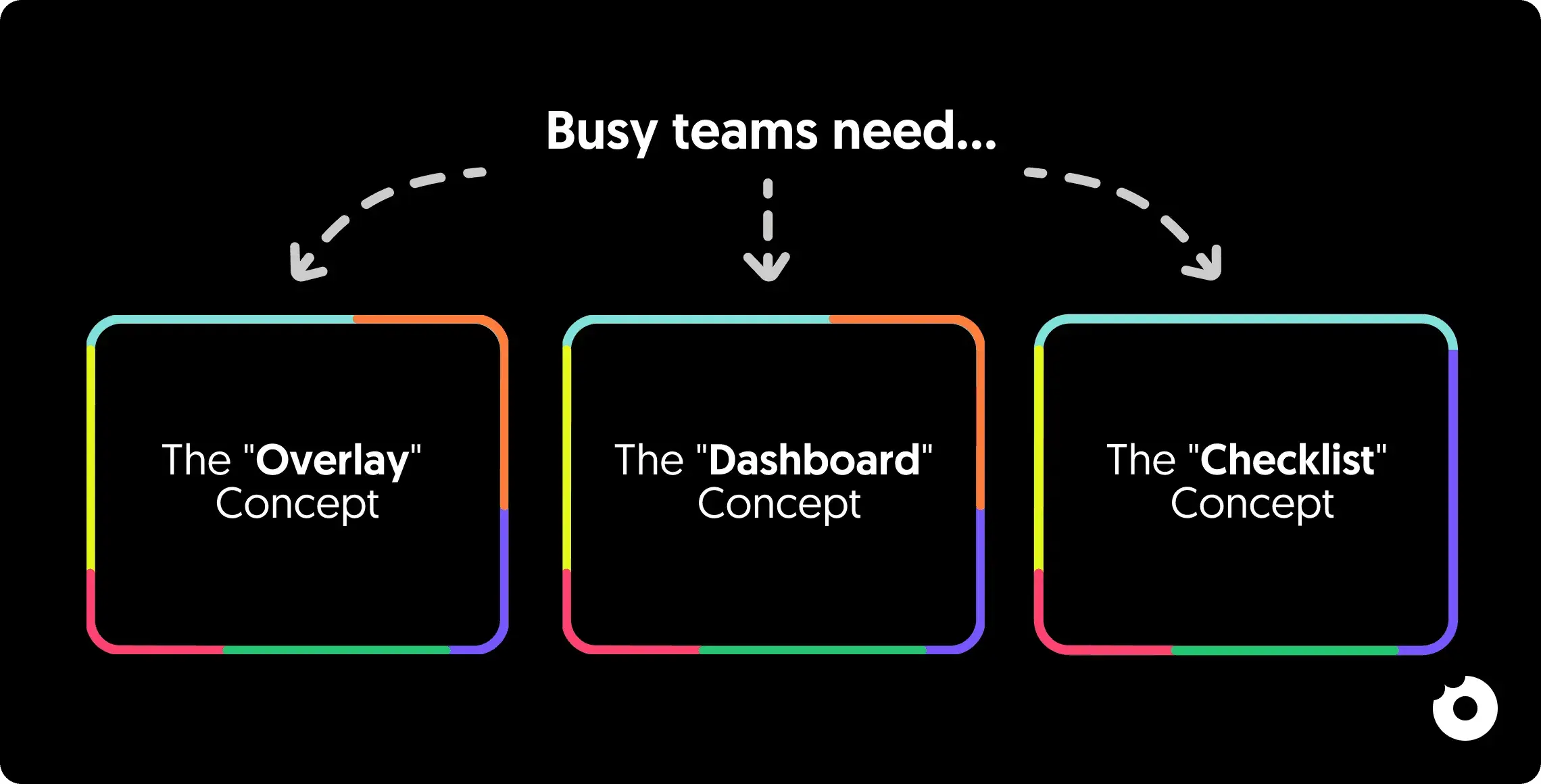
The "Overlay" Concept: A simple tool letting clients click directly on designs or documents to leave comments right where they belong.
The "Dashboard" Concept: A dedicated, client-facing portal showing project status, files ready for review, and a clear history of approvals.
The "Checklist" Concept: A super-streamlined, task-based view where each client deliverable had a simple "approve" or "request changes" checklist.

This approach of exploring multiple paths at once meant they could test different hypotheses without getting married to their first idea. Navigating this stage can be complex, and it's often where partnering with the right experts makes a difference. If you're looking for guidance, our guide on how to choose a B2B SaaS product design agency offers valuable insights.
Deliver: Refining and Validating the Winner
Finally, it was time for the Deliver phase. The team put their three concepts in front of real agency users and even a few of their friendly clients for usability testing. The "Dashboard" concept came out as the clear winner. Users absolutely loved the idea of a single source of truth for all client-facing communication and approvals.
With a winning direction, the team built a high-fidelity, interactive prototype of the dashboard and ran another round of testing. They polished the UI, simplified the onboarding flow, and made sure every click felt intuitive.
After a smooth handoff to development, the new Client Feedback Portal was launched. The results were almost immediate and easy to measure. Within three months, SyncFlow saw a 20% reduction in customer churn and a major lift in user engagement metrics. By taking the time to find and solve the right problem, they didn't just add a feature, they delivered massive business value.
Of course. Here is the rewritten section, designed to sound natural and human-written, while adhering to all your requirements.
Common Pitfalls and How to Avoid Them
The Double Diamond is a strong framework, but like any process, it comes with common pitfalls that can slow teams down if they’re not addressed early. Even seasoned teams run into predictable roadblocks that can slow things down or, worse, send a project completely off course. Knowing what these common traps look like is half the battle.
One of the biggest mistakes we see teams make, time and time again, is rushing through that first diamond. There’s always this immense pressure to start building something tangible right away. This often means the Discover phase gets cut short, which is a massive mistake. When you build on a foundation of shaky or incomplete assumptions, you almost always end up solving the wrong problem. All that time and money you thought you were saving? It comes back to bite you later.
Skipping Research and Misaligning Stakeholders
Rushing through Discover is one of the most common mistakes. When teams assume they already know the user, they end up designing for assumptions rather than real needs. This "we know what the user wants" attitude is the absolute enemy of good design. If you're not doing real user research, you're not designing for your customers; you're just designing for yourselves.
The fix is pretty simple: make research a non-negotiable step. Before you do anything else, put together a formal research plan. It doesn't have to be a novel, just a clear document with your goals, the questions you need answered, and how many users you'll talk to. It adds a necessary dose of discipline to the exploration.
Another classic pitfall is letting stakeholders drift out of alignment. If key decision-makers aren't part of the journey from the start, they can swoop in late in the game with feedback that forces you back to the drawing board. It’s frustrating, and it completely kills momentum. You can get ahead of this by setting up a regular cadence for stakeholder reviews. Quick, consistent check-ins are all it takes to make sure everyone feels involved and stays on the same page.
The goal is not just to inform stakeholders, but to make them active participants in the discovery process. When they see the user feedback firsthand, they become champions for the problem you’re trying to solve.
Getting Lost in Development
In the second diamond, teams often struggle with endless ideation. Without clear boundaries, creativity can stall progress instead of moving it forward. The Develop phase is supposed to be creative and expansive, but without some boundaries, it can quickly turn into a brainstorming black hole where no decisions get made. It's a classic case of "analysis paralysis," and it stops you from ever getting to a testable solution.
The secret weapon here is time-boxing. Set a timer and stick to it. Give your team a strict limit for creative exercises, a technique like Crazy 8s is perfect for this because it forces rapid-fire thinking. By setting a hard deadline to choose a couple of ideas to prototype, you keep the project moving forward and ensure all that creativity actually leads somewhere.
To make these points easier to remember, here's a quick summary of the most common challenges and how to get around them.
Common Pitfall | Phase Affected | Solution |
|---|---|---|
Rushing research | Discover | Create a formal research plan with clear goals and activities. |
Stakeholder misalignment | All Phases | Establish a rhythm of regular, brief stakeholder reviews. |
Endless ideation | Develop | Use time-boxing for brainstorming and set firm deadlines for convergence. |
Building on assumptions | Discover/Define | Mandate direct user interviews before defining the problem. |
Think of this table as a quick cheat sheet. If you feel your project starting to stall or go sideways, a quick look here might be all you need to spot the problem and get back on track.
Your Questions About the Double Diamond Answered
Even with a clear framework, teams often have practical questions before getting started. Let's tackle some of the most common practical things B2B SaaS teams ask about the double diamond design process.
Here are some quick, straightforward answers to help you get started with confidence.
How Long Should Each Phase Take?
Honestly, there's no magic number. The timeline for each phase really depends on the project's complexity, your team's size, and just how deep the problem you're trying to solve is.
A small feature update might zip through a full diamond in a couple of weeks. On the other hand, a massive product overhaul or building a new MVP from scratch could mean spending months in that first diamond alone.
Try not to get hung up on a rigid schedule. The real goal is giving each phase enough time to do its job properly, whether that's getting to the bottom of user needs in Discover or running solid tests in Deliver.
Can You Use It with Agile or Scrum?
Absolutely. In fact, they work brilliantly together. The Double Diamond is a way of thinking, a strategic framework for understanding problems and finding solutions. It's not a strict project management system.
Here's how to think about it:
The Double Diamond helps you figure out what to build and why it matters.
Agile or Scrum gives you the iterative process for how to build it well.
A common setup is to have your design team working a sprint or two ahead of the developers. So, while the engineering team is busy building features that were validated in the last cycle, the designers are already exploring the next big problem in a new diamond.
What Are the Essential Team Roles?
Job titles can be all over the place, but a strong team always has a core group of people who bring different skills and perspectives to the table. For a B2B SaaS team, that usually looks something like this:
Product Manager: This person owns the "why." They make sure everything you're doing lines up with the bigger business goals.
UX Researcher: They lead the charge in the Discover phase, digging deep to uncover those crucial user insights.
Product Designer (UX/UI): The one who turns all that research and insight into real, tangible prototypes and the final polished designs.
Lead Engineer: They provide a vital reality check on technical feasibility all the way through the process. It's no good designing something that can't be built.
Getting this mix of people working together is what really powers the Double Diamond and makes it work.
At Donux, we work right alongside B2B SaaS teams to answer these kinds of questions and put the Double Diamond process into action. Our goal is to help you build the right product, faster.
Book a discovery call with us and let's talk about how we can speed up your design and development.
The Double Diamond is less of a rigid process and more of a mental map. It guides product teams from the messy, uncertain beginning of a problem all the way to a clear, tested solution.
At its core, the framework follows a simple rhythm: explore broadly, then focus deliberately. This cycle happens twice: first to identify the right problem, and then to design the right solution.
What Is the Double Diamond Design Process?
Think of it like a good detective working a case. Before zeroing in on a suspect, they spend time at the crime scene, casting a wide net for clues and talking to everyone involved. That's the exploration phase, or divergent thinking. Only after gathering all the facts do they start connecting the dots, ruling out dead ends, and focusing on the most likely culprit. That's the convergent part.
The Double Diamond brings that same disciplined thinking to product design. It gives B2B SaaS teams a structured way to innovate, stopping them from prematurely jumping to a solution based on a hunch. It forces you to first get a deep understanding of the user and their world before you ever start brainstorming features.
This structured approach is a cornerstone of modern product design.
The Two Diamonds and Four Phases
The name comes from its shape: two diamonds placed side-by-side. Each diamond represents one cycle of exploring and then focusing.
The First Diamond (The Problem Space): This is all about research and strategy. The entire goal here is to find and validate the real problem. You start by exploring broadly (Discover) and finish by homing in on a crystal-clear problem statement (Define).
The Second Diamond (The Solution Space): This is where design and development kick in. You’re now focused on crafting the best possible answer to the problem you just defined. It starts with ideation and prototyping (Develop) and ends with a tested, polished solution ready for the real world (Deliver).
This flow provides a clear path from total ambiguity to confident clarity.

To make this even clearer, here’s a quick breakdown of what each phase is about.
The Four Phases of the Double Diamond Process
Phase | Thinking Style | Primary Goal |
|---|---|---|
Discover | Divergent | To understand the user and the problem space without bias. |
Define | Convergent | To synthesise research into a clear, actionable problem statement. |
Develop | Divergent | To explore, brainstorm, and prototype a wide range of potential solutions. |
Deliver | Convergent | To test, refine, and finalise the best solution for launch. |
This simple structure helps teams stay aligned and ensures that no critical step gets skipped on the way to building a great product.
A Proven Framework for Innovation
The Double Diamond isn't some new, untested trend. It was first popularised by the UK's Design Council way back in 2004 and has since become a standard in product development.
It has proven particularly effective in complex B2B sectors like business intelligence (BI). For instance, one 2023 study found that 68% of BI product teams in the UK and Europe now actively use its principles. That’s a huge leap from just 32% back in 2018, showing just how valuable this "explore-then-focus" mindset really is.
Getting to the Heart of the Real Problem
The journey into the Double Diamond design process doesn't start with brilliant ideas or flashy solutions. It starts with a deep, deliberate dive into the problem itself. This first diamond is all about making sure you’re solving the right problem, a step that often separates a product people love from one they ignore.
Too many teams get this wrong. They rush past the problem and build on shaky assumptions, only to end up with a perfectly engineered solution to an issue nobody actually has. The first diamond forces you to slow down, listen, and truly understand your users before a single line of code gets written.
The Discover Phase: Going Wide with Research
The Discover phase is about exploration without assumptions. The goal isn’t to confirm ideas, but to ask better questions and challenge what the team thinks it already knows.
Think of the team as investigative journalists: the task is to uncover the real story, even if it contradicts expectations. This means stepping into the user’s world and understanding their reality firsthand.

Common Activities in the Discover Phase
User Interviews: Real, one-on-one conversations to hear about users' motivations, frustrations, and daily routines in their own words.
Stakeholder Workshops: Getting everyone in the same room to align on business goals, technical limits, and what's already known.
Competitor Analysis: Taking a hard look at how other products are trying to solve similar problems, and where they're falling short.
Journey Mapping: Visualising a user's entire experience from start to finish to pinpoint the emotional highs and lows.
For B2B SaaS teams, this is non-negotiable. A FinTech team, for example, might assume their accounting users just want faster data entry. But after a few discovery interviews, they could find the real pain is a crippling anxiety around compliance regulations. That's a much more valuable and complex problem to solve. A solid discovery process is the bedrock of success; you can see more on the key steps in a product discovery engagement.
The Define Phase: Nailing Down the Core Problem
After the wide exploration of the Discover phase, the Define phase brings focus. This is where teams switch to convergent thinking, synthesising research, identifying patterns, and shaping one clear problem statement that will guide all future decisions.
This step is often the most challenging part of the first diamond. Messy, ambiguous insights have to be turned into clarity. The team moves from broad “what if” questions to a focused and actionable “how might we.”
The goal of Define isn’t to list every problem you’ve found, but to articulate the one problem that matters most, for both users and the business.
Done well, this focus pays off. Teams that follow the Double Diamond report higher launch success and lower development costs, largely because real user pain points are identified early and addressed deliberately.
Key Techniques for the Define Phase
Affinity Diagramming: Cluster research insights into themes to surface patterns.
“How Might We” Questions: Reframe insights into open, solution-friendly prompts.
The 5 Whys: Dig beneath surface issues to uncover root causes.
Problem Statement: A user-centred definition that’s focused, but flexible enough for creative solutions.
By the end of the Define phase, the team leaves ambiguity behind and enters the second diamond with a sharp understanding of the real problem, a foundation that makes designing the right solution possible.
Designing the Right Solution
We’ve navigated the first diamond and zeroed in on the right problem to solve. Now, it's time to enter the second diamond: the solution space. This is where we take all those abstract insights and user needs and start shaping them into a real, tangible product. The entire focus shifts from understanding the problem to building the right solution for it.
This part of the double diamond design process is where the magic really happens. It's an exciting blend of creativity, teamwork, and sharp-eyed evaluation that brings a concept to life. We start by casting a wide net for potential solutions before carefully homing in on the very best one to build and launch.

The Develop Phase: Exploring All Possibilities
The Develop phase opens the solution space. With a clear problem in mind, teams explore multiple directions, generate ideas, and prototype different ways forward, prioritising exploration over refinement.
Think of it like an architect sketching out initial ideas. Before they settle on a final blueprint, they'll draw dozens of concepts, some are practical, others are wonderfully out there. This exploration ensures they don't just grab the first, most obvious idea. In the world of B2B SaaS, this is crucial for avoiding the trap of getting locked into a single concept that's rarely the strongest one.
This phase is all about creating options and fostering a "yes, and..." culture. Every idea is put on the table, and judgement is put on hold. Creating that psychological safety is what allows the truly innovative approaches to surface.
Practical Ideation Methods for B2B SaaS
Structured Brainstorming: Techniques like Crazy 8s help teams generate ideas quickly and move past obvious solutions.
Storyboarding: Mapping the user journey makes key interactions and friction points visible early.
Rapid Prototyping: Low-fidelity wireframes in tools like Figma or Balsamiq help test concepts before investing in detail.
The goal isn’t a single polished design, but a small set of promising ideas ready for evaluation and testing.
The Deliver Phase: Refining the Final Product
The Deliver phase brings focus back in. The most promising solution is tested, refined, and prepared for development, ensuring it works in practice, not just in theory.
If Develop was about creating options, Deliver is about making confident decisions backed by real user data. The most promising prototypes get a major upgrade, evolving from rough sketches into high-fidelity, interactive models that look and feel just like the final product.
This is where the rubber meets the road. The goal is to rigorously test the chosen design with actual users to make sure it not only solves the problem but is also intuitive, efficient, and maybe even a little delightful to use.
The Deliver phase is the final quality gate. It’s where you prove your solution works not just in theory, but in the hands of the people who will use it every day. This step transforms a good idea into a great product experience.
This meticulous approach of developing and then delivering a tested solution has a massive impact. A 2024 review from Splunk on European IT sectors highlighted just how effective this framework is. They found that 73% of surveyed IT organisations saw 50% fewer post-launch issues after adopting it. To get the full story, you can read the complete analysis from Splunk.
Key Activities and Metrics for the Deliver Phase This final stage is all about structured validation and hitting clear checkpoints to ensure the solution is launch-ready.
High-Fidelity Prototyping: Designers craft detailed, interactive mockups in tools like Figma that are a spitting image of the final UI and UX. These are absolutely essential for running meaningful usability tests.
Usability Testing: This is the heart of the Deliver phase. We watch real users as they try to complete specific tasks with the high-fidelity prototype, gathering both hard data and priceless qualitative feedback on what’s working and what isn’t.
QA and Handoff Prep: Designers and engineers get in lockstep to make sure the final designs are technically feasible and well-documented. A smooth design handoff, often including a full component library or design system, is prepared to make the development process as seamless as possible.
Throughout this process, the team keeps a close eye on key performance indicators (KPIs) to measure success without any guesswork.
Metric | What It Measures | Why It's Important in B2B SaaS |
|---|---|---|
Task Completion Rate | The percentage of users who successfully complete a given task. | This tells you if the solution actually works for the complex workflows your users have. |
System Usability Scale (SUS) | A standard questionnaire to get a user's subjective rating of usability. | It provides a reliable score for overall user satisfaction and ease of use. |
Time on Task | The average time it takes a user to complete a task. | This is a direct measure of efficiency, a must-have for productivity-focused software. |
Error Rate | The number of mistakes users make while trying to complete a task. | This shines a spotlight on confusing or poorly designed parts of the interface. |
By the time the Deliver phase wraps up, the team has a validated, user-approved solution that's ready to be built. This tough final step ensures that what gets shipped isn't just another feature, but a valuable, polished addition that truly solves a real problem for your users.
The Double Diamond in Action for B2B SaaS
Theory is great, but let's be honest, it doesn't really sink in until you see how it works in the wild. To make this framework less abstract, we’ll walk through the journey of ‘SyncFlow’, a fictional project management tool designed for the fast-paced world of marketing agencies.
The SyncFlow team had a backlog overflowing with feature requests, but they had that nagging feeling they were out of touch with what their users really needed. So, they hit pause on building new stuff and committed to a full Double Diamond cycle to solve a problem that actually mattered.

Discover: Finding the Real Agency Pain Point
First up, the Discover phase. The SyncFlow team had to consciously step away from their own assumptions. Instead of just firing off another generic survey, they rolled up their sleeves and scheduled in-depth, one-on-one interviews with fifteen of their most active agency customers.
They went in fully expecting to hear gripes about their task management system or a need for better reporting dashboards. But something else entirely bubbled to the surface, again and again. The agencies weren't clamouring for more internal features; their biggest headache was the messy, time-sucking chaos of getting feedback and approvals from their own clients.
It was a story of lost emails, feedback scattered across ten different documents, and a total nightmare of version control. This was the real, unspoken friction point that was killing their productivity and straining their client relationships.
Define: Focusing on Client Collaboration
Armed with this treasure trove of qualitative data, the team moved into the Define phase. They broke out the sticky notes and used affinity mapping to cluster all their interview findings. The theme of "chaotic client feedback" was impossible to miss. They realised they weren't just building a project tool; they were mediating a critical business relationship.
This insight allowed them to narrow their focus and land on a clear, powerful problem statement:
"Busy marketing agency teams need a centralised and intuitive way to share work and gather feedback from their clients, because the current scattered process leads to project delays, miscommunication, and frustration on both sides."

Suddenly, they had a mission. This wasn't about adding another bell or whistle. It was about solving a high-stakes workflow that was causing everyone pain.
Develop: Exploring Potential Solutions
Now for the second diamond. The Develop phase kicked off with an intensive ideation workshop, using that problem statement as a launchpad for creativity. They brainstormed a whole spectrum of ideas, from simple commenting tools to full-blown, integrated client portals. No idea was a bad idea at this stage.
To test the waters, they quickly mocked up three distinct low-fidelity prototypes in Figma:
The "Overlay" Concept: A simple tool letting clients click directly on designs or documents to leave comments right where they belong.
The "Dashboard" Concept: A dedicated, client-facing portal showing project status, files ready for review, and a clear history of approvals.
The "Checklist" Concept: A super-streamlined, task-based view where each client deliverable had a simple "approve" or "request changes" checklist.

This approach of exploring multiple paths at once meant they could test different hypotheses without getting married to their first idea. Navigating this stage can be complex, and it's often where partnering with the right experts makes a difference. If you're looking for guidance, our guide on how to choose a B2B SaaS product design agency offers valuable insights.
Deliver: Refining and Validating the Winner
Finally, it was time for the Deliver phase. The team put their three concepts in front of real agency users and even a few of their friendly clients for usability testing. The "Dashboard" concept came out as the clear winner. Users absolutely loved the idea of a single source of truth for all client-facing communication and approvals.
With a winning direction, the team built a high-fidelity, interactive prototype of the dashboard and ran another round of testing. They polished the UI, simplified the onboarding flow, and made sure every click felt intuitive.
After a smooth handoff to development, the new Client Feedback Portal was launched. The results were almost immediate and easy to measure. Within three months, SyncFlow saw a 20% reduction in customer churn and a major lift in user engagement metrics. By taking the time to find and solve the right problem, they didn't just add a feature, they delivered massive business value.
Of course. Here is the rewritten section, designed to sound natural and human-written, while adhering to all your requirements.
Common Pitfalls and How to Avoid Them

The Double Diamond is a strong framework, but like any process, it comes with common pitfalls that can slow teams down if they’re not addressed early. Even seasoned teams run into predictable roadblocks that can slow things down or, worse, send a project completely off course. Knowing what these common traps look like is half the battle.
One of the biggest mistakes we see teams make, time and time again, is rushing through that first diamond. There’s always this immense pressure to start building something tangible right away. This often means the Discover phase gets cut short, which is a massive mistake. When you build on a foundation of shaky or incomplete assumptions, you almost always end up solving the wrong problem. All that time and money you thought you were saving? It comes back to bite you later.
Skipping Research and Misaligning Stakeholders
Rushing through Discover is one of the most common mistakes. When teams assume they already know the user, they end up designing for assumptions rather than real needs. This "we know what the user wants" attitude is the absolute enemy of good design. If you're not doing real user research, you're not designing for your customers; you're just designing for yourselves.
The fix is pretty simple: make research a non-negotiable step. Before you do anything else, put together a formal research plan. It doesn't have to be a novel, just a clear document with your goals, the questions you need answered, and how many users you'll talk to. It adds a necessary dose of discipline to the exploration.
Another classic pitfall is letting stakeholders drift out of alignment. If key decision-makers aren't part of the journey from the start, they can swoop in late in the game with feedback that forces you back to the drawing board. It’s frustrating, and it completely kills momentum. You can get ahead of this by setting up a regular cadence for stakeholder reviews. Quick, consistent check-ins are all it takes to make sure everyone feels involved and stays on the same page.
The goal is not just to inform stakeholders, but to make them active participants in the discovery process. When they see the user feedback firsthand, they become champions for the problem you’re trying to solve.
Getting Lost in Development
In the second diamond, teams often struggle with endless ideation. Without clear boundaries, creativity can stall progress instead of moving it forward. The Develop phase is supposed to be creative and expansive, but without some boundaries, it can quickly turn into a brainstorming black hole where no decisions get made. It's a classic case of "analysis paralysis," and it stops you from ever getting to a testable solution.
The secret weapon here is time-boxing. Set a timer and stick to it. Give your team a strict limit for creative exercises, a technique like Crazy 8s is perfect for this because it forces rapid-fire thinking. By setting a hard deadline to choose a couple of ideas to prototype, you keep the project moving forward and ensure all that creativity actually leads somewhere.
To make these points easier to remember, here's a quick summary of the most common challenges and how to get around them.
Common Pitfall | Phase Affected | Solution |
|---|---|---|
Rushing research | Discover | Create a formal research plan with clear goals and activities. |
Stakeholder misalignment | All Phases | Establish a rhythm of regular, brief stakeholder reviews. |
Endless ideation | Develop | Use time-boxing for brainstorming and set firm deadlines for convergence. |
Building on assumptions | Discover/Define | Mandate direct user interviews before defining the problem. |
Think of this table as a quick cheat sheet. If you feel your project starting to stall or go sideways, a quick look here might be all you need to spot the problem and get back on track.
Your Questions About the Double Diamond Answered

Even with a clear framework, teams often have practical questions before getting started. Let's tackle some of the most common practical things B2B SaaS teams ask about the double diamond design process.
Here are some quick, straightforward answers to help you get started with confidence.
How Long Should Each Phase Take?
Honestly, there's no magic number. The timeline for each phase really depends on the project's complexity, your team's size, and just how deep the problem you're trying to solve is.
A small feature update might zip through a full diamond in a couple of weeks. On the other hand, a massive product overhaul or building a new MVP from scratch could mean spending months in that first diamond alone.
Try not to get hung up on a rigid schedule. The real goal is giving each phase enough time to do its job properly, whether that's getting to the bottom of user needs in Discover or running solid tests in Deliver.
Can You Use It with Agile or Scrum?
Absolutely. In fact, they work brilliantly together. The Double Diamond is a way of thinking, a strategic framework for understanding problems and finding solutions. It's not a strict project management system.
Here's how to think about it:
The Double Diamond helps you figure out what to build and why it matters.
Agile or Scrum gives you the iterative process for how to build it well.
A common setup is to have your design team working a sprint or two ahead of the developers. So, while the engineering team is busy building features that were validated in the last cycle, the designers are already exploring the next big problem in a new diamond.
What Are the Essential Team Roles?
Job titles can be all over the place, but a strong team always has a core group of people who bring different skills and perspectives to the table. For a B2B SaaS team, that usually looks something like this:
Product Manager: This person owns the "why." They make sure everything you're doing lines up with the bigger business goals.
UX Researcher: They lead the charge in the Discover phase, digging deep to uncover those crucial user insights.
Product Designer (UX/UI): The one who turns all that research and insight into real, tangible prototypes and the final polished designs.
Lead Engineer: They provide a vital reality check on technical feasibility all the way through the process. It's no good designing something that can't be built.
Getting this mix of people working together is what really powers the Double Diamond and makes it work.
At Donux, we work right alongside B2B SaaS teams to answer these kinds of questions and put the Double Diamond process into action. Our goal is to help you build the right product, faster.
Book a discovery call with us and let's talk about how we can speed up your design and development.
The Double Diamond is less of a rigid process and more of a mental map. It guides product teams from the messy, uncertain beginning of a problem all the way to a clear, tested solution.
At its core, the framework follows a simple rhythm: explore broadly, then focus deliberately. This cycle happens twice: first to identify the right problem, and then to design the right solution.
What Is the Double Diamond Design Process?
Think of it like a good detective working a case. Before zeroing in on a suspect, they spend time at the crime scene, casting a wide net for clues and talking to everyone involved. That's the exploration phase, or divergent thinking. Only after gathering all the facts do they start connecting the dots, ruling out dead ends, and focusing on the most likely culprit. That's the convergent part.
The Double Diamond brings that same disciplined thinking to product design. It gives B2B SaaS teams a structured way to innovate, stopping them from prematurely jumping to a solution based on a hunch. It forces you to first get a deep understanding of the user and their world before you ever start brainstorming features.
This structured approach is a cornerstone of modern product design.
The Two Diamonds and Four Phases
The name comes from its shape: two diamonds placed side-by-side. Each diamond represents one cycle of exploring and then focusing.
The First Diamond (The Problem Space): This is all about research and strategy. The entire goal here is to find and validate the real problem. You start by exploring broadly (Discover) and finish by homing in on a crystal-clear problem statement (Define).
The Second Diamond (The Solution Space): This is where design and development kick in. You’re now focused on crafting the best possible answer to the problem you just defined. It starts with ideation and prototyping (Develop) and ends with a tested, polished solution ready for the real world (Deliver).
This flow provides a clear path from total ambiguity to confident clarity.

To make this even clearer, here’s a quick breakdown of what each phase is about.
The Four Phases of the Double Diamond Process
Phase | Thinking Style | Primary Goal |
|---|---|---|
Discover | Divergent | To understand the user and the problem space without bias. |
Define | Convergent | To synthesise research into a clear, actionable problem statement. |
Develop | Divergent | To explore, brainstorm, and prototype a wide range of potential solutions. |
Deliver | Convergent | To test, refine, and finalise the best solution for launch. |
This simple structure helps teams stay aligned and ensures that no critical step gets skipped on the way to building a great product.
A Proven Framework for Innovation
The Double Diamond isn't some new, untested trend. It was first popularised by the UK's Design Council way back in 2004 and has since become a standard in product development.
It has proven particularly effective in complex B2B sectors like business intelligence (BI). For instance, one 2023 study found that 68% of BI product teams in the UK and Europe now actively use its principles. That’s a huge leap from just 32% back in 2018, showing just how valuable this "explore-then-focus" mindset really is.
Getting to the Heart of the Real Problem
The journey into the Double Diamond design process doesn't start with brilliant ideas or flashy solutions. It starts with a deep, deliberate dive into the problem itself. This first diamond is all about making sure you’re solving the right problem, a step that often separates a product people love from one they ignore.
Too many teams get this wrong. They rush past the problem and build on shaky assumptions, only to end up with a perfectly engineered solution to an issue nobody actually has. The first diamond forces you to slow down, listen, and truly understand your users before a single line of code gets written.
The Discover Phase: Going Wide with Research
The Discover phase is about exploration without assumptions. The goal isn’t to confirm ideas, but to ask better questions and challenge what the team thinks it already knows.
Think of the team as investigative journalists: the task is to uncover the real story, even if it contradicts expectations. This means stepping into the user’s world and understanding their reality firsthand.

Common Activities in the Discover Phase
User Interviews: Real, one-on-one conversations to hear about users' motivations, frustrations, and daily routines in their own words.
Stakeholder Workshops: Getting everyone in the same room to align on business goals, technical limits, and what's already known.
Competitor Analysis: Taking a hard look at how other products are trying to solve similar problems, and where they're falling short.
Journey Mapping: Visualising a user's entire experience from start to finish to pinpoint the emotional highs and lows.
For B2B SaaS teams, this is non-negotiable. A FinTech team, for example, might assume their accounting users just want faster data entry. But after a few discovery interviews, they could find the real pain is a crippling anxiety around compliance regulations. That's a much more valuable and complex problem to solve. A solid discovery process is the bedrock of success; you can see more on the key steps in a product discovery engagement.
The Define Phase: Nailing Down the Core Problem
After the wide exploration of the Discover phase, the Define phase brings focus. This is where teams switch to convergent thinking, synthesising research, identifying patterns, and shaping one clear problem statement that will guide all future decisions.
This step is often the most challenging part of the first diamond. Messy, ambiguous insights have to be turned into clarity. The team moves from broad “what if” questions to a focused and actionable “how might we.”
The goal of Define isn’t to list every problem you’ve found, but to articulate the one problem that matters most, for both users and the business.
Done well, this focus pays off. Teams that follow the Double Diamond report higher launch success and lower development costs, largely because real user pain points are identified early and addressed deliberately.
Key Techniques for the Define Phase
Affinity Diagramming: Cluster research insights into themes to surface patterns.
“How Might We” Questions: Reframe insights into open, solution-friendly prompts.
The 5 Whys: Dig beneath surface issues to uncover root causes.
Problem Statement: A user-centred definition that’s focused, but flexible enough for creative solutions.
By the end of the Define phase, the team leaves ambiguity behind and enters the second diamond with a sharp understanding of the real problem, a foundation that makes designing the right solution possible.
Designing the Right Solution
We’ve navigated the first diamond and zeroed in on the right problem to solve. Now, it's time to enter the second diamond: the solution space. This is where we take all those abstract insights and user needs and start shaping them into a real, tangible product. The entire focus shifts from understanding the problem to building the right solution for it.
This part of the double diamond design process is where the magic really happens. It's an exciting blend of creativity, teamwork, and sharp-eyed evaluation that brings a concept to life. We start by casting a wide net for potential solutions before carefully homing in on the very best one to build and launch.

The Develop Phase: Exploring All Possibilities
The Develop phase opens the solution space. With a clear problem in mind, teams explore multiple directions, generate ideas, and prototype different ways forward, prioritising exploration over refinement.
Think of it like an architect sketching out initial ideas. Before they settle on a final blueprint, they'll draw dozens of concepts, some are practical, others are wonderfully out there. This exploration ensures they don't just grab the first, most obvious idea. In the world of B2B SaaS, this is crucial for avoiding the trap of getting locked into a single concept that's rarely the strongest one.
This phase is all about creating options and fostering a "yes, and..." culture. Every idea is put on the table, and judgement is put on hold. Creating that psychological safety is what allows the truly innovative approaches to surface.
Practical Ideation Methods for B2B SaaS
Structured Brainstorming: Techniques like Crazy 8s help teams generate ideas quickly and move past obvious solutions.
Storyboarding: Mapping the user journey makes key interactions and friction points visible early.
Rapid Prototyping: Low-fidelity wireframes in tools like Figma or Balsamiq help test concepts before investing in detail.
The goal isn’t a single polished design, but a small set of promising ideas ready for evaluation and testing.
The Deliver Phase: Refining the Final Product
The Deliver phase brings focus back in. The most promising solution is tested, refined, and prepared for development, ensuring it works in practice, not just in theory.
If Develop was about creating options, Deliver is about making confident decisions backed by real user data. The most promising prototypes get a major upgrade, evolving from rough sketches into high-fidelity, interactive models that look and feel just like the final product.
This is where the rubber meets the road. The goal is to rigorously test the chosen design with actual users to make sure it not only solves the problem but is also intuitive, efficient, and maybe even a little delightful to use.
The Deliver phase is the final quality gate. It’s where you prove your solution works not just in theory, but in the hands of the people who will use it every day. This step transforms a good idea into a great product experience.
This meticulous approach of developing and then delivering a tested solution has a massive impact. A 2024 review from Splunk on European IT sectors highlighted just how effective this framework is. They found that 73% of surveyed IT organisations saw 50% fewer post-launch issues after adopting it. To get the full story, you can read the complete analysis from Splunk.
Key Activities and Metrics for the Deliver Phase This final stage is all about structured validation and hitting clear checkpoints to ensure the solution is launch-ready.
High-Fidelity Prototyping: Designers craft detailed, interactive mockups in tools like Figma that are a spitting image of the final UI and UX. These are absolutely essential for running meaningful usability tests.
Usability Testing: This is the heart of the Deliver phase. We watch real users as they try to complete specific tasks with the high-fidelity prototype, gathering both hard data and priceless qualitative feedback on what’s working and what isn’t.
QA and Handoff Prep: Designers and engineers get in lockstep to make sure the final designs are technically feasible and well-documented. A smooth design handoff, often including a full component library or design system, is prepared to make the development process as seamless as possible.
Throughout this process, the team keeps a close eye on key performance indicators (KPIs) to measure success without any guesswork.
Metric | What It Measures | Why It's Important in B2B SaaS |
|---|---|---|
Task Completion Rate | The percentage of users who successfully complete a given task. | This tells you if the solution actually works for the complex workflows your users have. |
System Usability Scale (SUS) | A standard questionnaire to get a user's subjective rating of usability. | It provides a reliable score for overall user satisfaction and ease of use. |
Time on Task | The average time it takes a user to complete a task. | This is a direct measure of efficiency, a must-have for productivity-focused software. |
Error Rate | The number of mistakes users make while trying to complete a task. | This shines a spotlight on confusing or poorly designed parts of the interface. |
By the time the Deliver phase wraps up, the team has a validated, user-approved solution that's ready to be built. This tough final step ensures that what gets shipped isn't just another feature, but a valuable, polished addition that truly solves a real problem for your users.
The Double Diamond in Action for B2B SaaS
Theory is great, but let's be honest, it doesn't really sink in until you see how it works in the wild. To make this framework less abstract, we’ll walk through the journey of ‘SyncFlow’, a fictional project management tool designed for the fast-paced world of marketing agencies.
The SyncFlow team had a backlog overflowing with feature requests, but they had that nagging feeling they were out of touch with what their users really needed. So, they hit pause on building new stuff and committed to a full Double Diamond cycle to solve a problem that actually mattered.

Discover: Finding the Real Agency Pain Point
First up, the Discover phase. The SyncFlow team had to consciously step away from their own assumptions. Instead of just firing off another generic survey, they rolled up their sleeves and scheduled in-depth, one-on-one interviews with fifteen of their most active agency customers.
They went in fully expecting to hear gripes about their task management system or a need for better reporting dashboards. But something else entirely bubbled to the surface, again and again. The agencies weren't clamouring for more internal features; their biggest headache was the messy, time-sucking chaos of getting feedback and approvals from their own clients.
It was a story of lost emails, feedback scattered across ten different documents, and a total nightmare of version control. This was the real, unspoken friction point that was killing their productivity and straining their client relationships.
Define: Focusing on Client Collaboration
Armed with this treasure trove of qualitative data, the team moved into the Define phase. They broke out the sticky notes and used affinity mapping to cluster all their interview findings. The theme of "chaotic client feedback" was impossible to miss. They realised they weren't just building a project tool; they were mediating a critical business relationship.
This insight allowed them to narrow their focus and land on a clear, powerful problem statement:
"Busy marketing agency teams need a centralised and intuitive way to share work and gather feedback from their clients, because the current scattered process leads to project delays, miscommunication, and frustration on both sides."

Suddenly, they had a mission. This wasn't about adding another bell or whistle. It was about solving a high-stakes workflow that was causing everyone pain.
Develop: Exploring Potential Solutions
Now for the second diamond. The Develop phase kicked off with an intensive ideation workshop, using that problem statement as a launchpad for creativity. They brainstormed a whole spectrum of ideas, from simple commenting tools to full-blown, integrated client portals. No idea was a bad idea at this stage.
To test the waters, they quickly mocked up three distinct low-fidelity prototypes in Figma:
The "Overlay" Concept: A simple tool letting clients click directly on designs or documents to leave comments right where they belong.
The "Dashboard" Concept: A dedicated, client-facing portal showing project status, files ready for review, and a clear history of approvals.
The "Checklist" Concept: A super-streamlined, task-based view where each client deliverable had a simple "approve" or "request changes" checklist.

This approach of exploring multiple paths at once meant they could test different hypotheses without getting married to their first idea. Navigating this stage can be complex, and it's often where partnering with the right experts makes a difference. If you're looking for guidance, our guide on how to choose a B2B SaaS product design agency offers valuable insights.
Deliver: Refining and Validating the Winner
Finally, it was time for the Deliver phase. The team put their three concepts in front of real agency users and even a few of their friendly clients for usability testing. The "Dashboard" concept came out as the clear winner. Users absolutely loved the idea of a single source of truth for all client-facing communication and approvals.
With a winning direction, the team built a high-fidelity, interactive prototype of the dashboard and ran another round of testing. They polished the UI, simplified the onboarding flow, and made sure every click felt intuitive.
After a smooth handoff to development, the new Client Feedback Portal was launched. The results were almost immediate and easy to measure. Within three months, SyncFlow saw a 20% reduction in customer churn and a major lift in user engagement metrics. By taking the time to find and solve the right problem, they didn't just add a feature, they delivered massive business value.
Of course. Here is the rewritten section, designed to sound natural and human-written, while adhering to all your requirements.
Common Pitfalls and How to Avoid Them

The Double Diamond is a strong framework, but like any process, it comes with common pitfalls that can slow teams down if they’re not addressed early. Even seasoned teams run into predictable roadblocks that can slow things down or, worse, send a project completely off course. Knowing what these common traps look like is half the battle.
One of the biggest mistakes we see teams make, time and time again, is rushing through that first diamond. There’s always this immense pressure to start building something tangible right away. This often means the Discover phase gets cut short, which is a massive mistake. When you build on a foundation of shaky or incomplete assumptions, you almost always end up solving the wrong problem. All that time and money you thought you were saving? It comes back to bite you later.
Skipping Research and Misaligning Stakeholders
Rushing through Discover is one of the most common mistakes. When teams assume they already know the user, they end up designing for assumptions rather than real needs. This "we know what the user wants" attitude is the absolute enemy of good design. If you're not doing real user research, you're not designing for your customers; you're just designing for yourselves.
The fix is pretty simple: make research a non-negotiable step. Before you do anything else, put together a formal research plan. It doesn't have to be a novel, just a clear document with your goals, the questions you need answered, and how many users you'll talk to. It adds a necessary dose of discipline to the exploration.
Another classic pitfall is letting stakeholders drift out of alignment. If key decision-makers aren't part of the journey from the start, they can swoop in late in the game with feedback that forces you back to the drawing board. It’s frustrating, and it completely kills momentum. You can get ahead of this by setting up a regular cadence for stakeholder reviews. Quick, consistent check-ins are all it takes to make sure everyone feels involved and stays on the same page.
The goal is not just to inform stakeholders, but to make them active participants in the discovery process. When they see the user feedback firsthand, they become champions for the problem you’re trying to solve.
Getting Lost in Development
In the second diamond, teams often struggle with endless ideation. Without clear boundaries, creativity can stall progress instead of moving it forward. The Develop phase is supposed to be creative and expansive, but without some boundaries, it can quickly turn into a brainstorming black hole where no decisions get made. It's a classic case of "analysis paralysis," and it stops you from ever getting to a testable solution.
The secret weapon here is time-boxing. Set a timer and stick to it. Give your team a strict limit for creative exercises, a technique like Crazy 8s is perfect for this because it forces rapid-fire thinking. By setting a hard deadline to choose a couple of ideas to prototype, you keep the project moving forward and ensure all that creativity actually leads somewhere.
To make these points easier to remember, here's a quick summary of the most common challenges and how to get around them.
Common Pitfall | Phase Affected | Solution |
|---|---|---|
Rushing research | Discover | Create a formal research plan with clear goals and activities. |
Stakeholder misalignment | All Phases | Establish a rhythm of regular, brief stakeholder reviews. |
Endless ideation | Develop | Use time-boxing for brainstorming and set firm deadlines for convergence. |
Building on assumptions | Discover/Define | Mandate direct user interviews before defining the problem. |
Think of this table as a quick cheat sheet. If you feel your project starting to stall or go sideways, a quick look here might be all you need to spot the problem and get back on track.
Your Questions About the Double Diamond Answered

Even with a clear framework, teams often have practical questions before getting started. Let's tackle some of the most common practical things B2B SaaS teams ask about the double diamond design process.
Here are some quick, straightforward answers to help you get started with confidence.
How Long Should Each Phase Take?
Honestly, there's no magic number. The timeline for each phase really depends on the project's complexity, your team's size, and just how deep the problem you're trying to solve is.
A small feature update might zip through a full diamond in a couple of weeks. On the other hand, a massive product overhaul or building a new MVP from scratch could mean spending months in that first diamond alone.
Try not to get hung up on a rigid schedule. The real goal is giving each phase enough time to do its job properly, whether that's getting to the bottom of user needs in Discover or running solid tests in Deliver.
Can You Use It with Agile or Scrum?
Absolutely. In fact, they work brilliantly together. The Double Diamond is a way of thinking, a strategic framework for understanding problems and finding solutions. It's not a strict project management system.
Here's how to think about it:
The Double Diamond helps you figure out what to build and why it matters.
Agile or Scrum gives you the iterative process for how to build it well.
A common setup is to have your design team working a sprint or two ahead of the developers. So, while the engineering team is busy building features that were validated in the last cycle, the designers are already exploring the next big problem in a new diamond.
What Are the Essential Team Roles?
Job titles can be all over the place, but a strong team always has a core group of people who bring different skills and perspectives to the table. For a B2B SaaS team, that usually looks something like this:
Product Manager: This person owns the "why." They make sure everything you're doing lines up with the bigger business goals.
UX Researcher: They lead the charge in the Discover phase, digging deep to uncover those crucial user insights.
Product Designer (UX/UI): The one who turns all that research and insight into real, tangible prototypes and the final polished designs.
Lead Engineer: They provide a vital reality check on technical feasibility all the way through the process. It's no good designing something that can't be built.
Getting this mix of people working together is what really powers the Double Diamond and makes it work.
At Donux, we work right alongside B2B SaaS teams to answer these kinds of questions and put the Double Diamond process into action. Our goal is to help you build the right product, faster.
Book a discovery call with us and let's talk about how we can speed up your design and development.
The Double Diamond is less of a rigid process and more of a mental map. It guides product teams from the messy, uncertain beginning of a problem all the way to a clear, tested solution.
At its core, the framework follows a simple rhythm: explore broadly, then focus deliberately. This cycle happens twice: first to identify the right problem, and then to design the right solution.
What Is the Double Diamond Design Process?
Think of it like a good detective working a case. Before zeroing in on a suspect, they spend time at the crime scene, casting a wide net for clues and talking to everyone involved. That's the exploration phase, or divergent thinking. Only after gathering all the facts do they start connecting the dots, ruling out dead ends, and focusing on the most likely culprit. That's the convergent part.
The Double Diamond brings that same disciplined thinking to product design. It gives B2B SaaS teams a structured way to innovate, stopping them from prematurely jumping to a solution based on a hunch. It forces you to first get a deep understanding of the user and their world before you ever start brainstorming features.
This structured approach is a cornerstone of modern product design.
The Two Diamonds and Four Phases
The name comes from its shape: two diamonds placed side-by-side. Each diamond represents one cycle of exploring and then focusing.
The First Diamond (The Problem Space): This is all about research and strategy. The entire goal here is to find and validate the real problem. You start by exploring broadly (Discover) and finish by homing in on a crystal-clear problem statement (Define).
The Second Diamond (The Solution Space): This is where design and development kick in. You’re now focused on crafting the best possible answer to the problem you just defined. It starts with ideation and prototyping (Develop) and ends with a tested, polished solution ready for the real world (Deliver).
This flow provides a clear path from total ambiguity to confident clarity.

To make this even clearer, here’s a quick breakdown of what each phase is about.
The Four Phases of the Double Diamond Process
Phase | Thinking Style | Primary Goal |
|---|---|---|
Discover | Divergent | To understand the user and the problem space without bias. |
Define | Convergent | To synthesise research into a clear, actionable problem statement. |
Develop | Divergent | To explore, brainstorm, and prototype a wide range of potential solutions. |
Deliver | Convergent | To test, refine, and finalise the best solution for launch. |
This simple structure helps teams stay aligned and ensures that no critical step gets skipped on the way to building a great product.
A Proven Framework for Innovation
The Double Diamond isn't some new, untested trend. It was first popularised by the UK's Design Council way back in 2004 and has since become a standard in product development.
It has proven particularly effective in complex B2B sectors like business intelligence (BI). For instance, one 2023 study found that 68% of BI product teams in the UK and Europe now actively use its principles. That’s a huge leap from just 32% back in 2018, showing just how valuable this "explore-then-focus" mindset really is.
Getting to the Heart of the Real Problem
The journey into the Double Diamond design process doesn't start with brilliant ideas or flashy solutions. It starts with a deep, deliberate dive into the problem itself. This first diamond is all about making sure you’re solving the right problem, a step that often separates a product people love from one they ignore.
Too many teams get this wrong. They rush past the problem and build on shaky assumptions, only to end up with a perfectly engineered solution to an issue nobody actually has. The first diamond forces you to slow down, listen, and truly understand your users before a single line of code gets written.
The Discover Phase: Going Wide with Research
The Discover phase is about exploration without assumptions. The goal isn’t to confirm ideas, but to ask better questions and challenge what the team thinks it already knows.
Think of the team as investigative journalists: the task is to uncover the real story, even if it contradicts expectations. This means stepping into the user’s world and understanding their reality firsthand.

Common Activities in the Discover Phase
User Interviews: Real, one-on-one conversations to hear about users' motivations, frustrations, and daily routines in their own words.
Stakeholder Workshops: Getting everyone in the same room to align on business goals, technical limits, and what's already known.
Competitor Analysis: Taking a hard look at how other products are trying to solve similar problems, and where they're falling short.
Journey Mapping: Visualising a user's entire experience from start to finish to pinpoint the emotional highs and lows.
For B2B SaaS teams, this is non-negotiable. A FinTech team, for example, might assume their accounting users just want faster data entry. But after a few discovery interviews, they could find the real pain is a crippling anxiety around compliance regulations. That's a much more valuable and complex problem to solve. A solid discovery process is the bedrock of success; you can see more on the key steps in a product discovery engagement.
The Define Phase: Nailing Down the Core Problem
After the wide exploration of the Discover phase, the Define phase brings focus. This is where teams switch to convergent thinking, synthesising research, identifying patterns, and shaping one clear problem statement that will guide all future decisions.
This step is often the most challenging part of the first diamond. Messy, ambiguous insights have to be turned into clarity. The team moves from broad “what if” questions to a focused and actionable “how might we.”
The goal of Define isn’t to list every problem you’ve found, but to articulate the one problem that matters most, for both users and the business.
Done well, this focus pays off. Teams that follow the Double Diamond report higher launch success and lower development costs, largely because real user pain points are identified early and addressed deliberately.
Key Techniques for the Define Phase
Affinity Diagramming: Cluster research insights into themes to surface patterns.
“How Might We” Questions: Reframe insights into open, solution-friendly prompts.
The 5 Whys: Dig beneath surface issues to uncover root causes.
Problem Statement: A user-centred definition that’s focused, but flexible enough for creative solutions.
By the end of the Define phase, the team leaves ambiguity behind and enters the second diamond with a sharp understanding of the real problem, a foundation that makes designing the right solution possible.
Designing the Right Solution
We’ve navigated the first diamond and zeroed in on the right problem to solve. Now, it's time to enter the second diamond: the solution space. This is where we take all those abstract insights and user needs and start shaping them into a real, tangible product. The entire focus shifts from understanding the problem to building the right solution for it.
This part of the double diamond design process is where the magic really happens. It's an exciting blend of creativity, teamwork, and sharp-eyed evaluation that brings a concept to life. We start by casting a wide net for potential solutions before carefully homing in on the very best one to build and launch.

The Develop Phase: Exploring All Possibilities
The Develop phase opens the solution space. With a clear problem in mind, teams explore multiple directions, generate ideas, and prototype different ways forward, prioritising exploration over refinement.
Think of it like an architect sketching out initial ideas. Before they settle on a final blueprint, they'll draw dozens of concepts, some are practical, others are wonderfully out there. This exploration ensures they don't just grab the first, most obvious idea. In the world of B2B SaaS, this is crucial for avoiding the trap of getting locked into a single concept that's rarely the strongest one.
This phase is all about creating options and fostering a "yes, and..." culture. Every idea is put on the table, and judgement is put on hold. Creating that psychological safety is what allows the truly innovative approaches to surface.
Practical Ideation Methods for B2B SaaS
Structured Brainstorming: Techniques like Crazy 8s help teams generate ideas quickly and move past obvious solutions.
Storyboarding: Mapping the user journey makes key interactions and friction points visible early.
Rapid Prototyping: Low-fidelity wireframes in tools like Figma or Balsamiq help test concepts before investing in detail.
The goal isn’t a single polished design, but a small set of promising ideas ready for evaluation and testing.
The Deliver Phase: Refining the Final Product
The Deliver phase brings focus back in. The most promising solution is tested, refined, and prepared for development, ensuring it works in practice, not just in theory.
If Develop was about creating options, Deliver is about making confident decisions backed by real user data. The most promising prototypes get a major upgrade, evolving from rough sketches into high-fidelity, interactive models that look and feel just like the final product.
This is where the rubber meets the road. The goal is to rigorously test the chosen design with actual users to make sure it not only solves the problem but is also intuitive, efficient, and maybe even a little delightful to use.
The Deliver phase is the final quality gate. It’s where you prove your solution works not just in theory, but in the hands of the people who will use it every day. This step transforms a good idea into a great product experience.
This meticulous approach of developing and then delivering a tested solution has a massive impact. A 2024 review from Splunk on European IT sectors highlighted just how effective this framework is. They found that 73% of surveyed IT organisations saw 50% fewer post-launch issues after adopting it. To get the full story, you can read the complete analysis from Splunk.
Key Activities and Metrics for the Deliver Phase This final stage is all about structured validation and hitting clear checkpoints to ensure the solution is launch-ready.
High-Fidelity Prototyping: Designers craft detailed, interactive mockups in tools like Figma that are a spitting image of the final UI and UX. These are absolutely essential for running meaningful usability tests.
Usability Testing: This is the heart of the Deliver phase. We watch real users as they try to complete specific tasks with the high-fidelity prototype, gathering both hard data and priceless qualitative feedback on what’s working and what isn’t.
QA and Handoff Prep: Designers and engineers get in lockstep to make sure the final designs are technically feasible and well-documented. A smooth design handoff, often including a full component library or design system, is prepared to make the development process as seamless as possible.
Throughout this process, the team keeps a close eye on key performance indicators (KPIs) to measure success without any guesswork.
Metric | What It Measures | Why It's Important in B2B SaaS |
|---|---|---|
Task Completion Rate | The percentage of users who successfully complete a given task. | This tells you if the solution actually works for the complex workflows your users have. |
System Usability Scale (SUS) | A standard questionnaire to get a user's subjective rating of usability. | It provides a reliable score for overall user satisfaction and ease of use. |
Time on Task | The average time it takes a user to complete a task. | This is a direct measure of efficiency, a must-have for productivity-focused software. |
Error Rate | The number of mistakes users make while trying to complete a task. | This shines a spotlight on confusing or poorly designed parts of the interface. |
By the time the Deliver phase wraps up, the team has a validated, user-approved solution that's ready to be built. This tough final step ensures that what gets shipped isn't just another feature, but a valuable, polished addition that truly solves a real problem for your users.
The Double Diamond in Action for B2B SaaS
Theory is great, but let's be honest, it doesn't really sink in until you see how it works in the wild. To make this framework less abstract, we’ll walk through the journey of ‘SyncFlow’, a fictional project management tool designed for the fast-paced world of marketing agencies.
The SyncFlow team had a backlog overflowing with feature requests, but they had that nagging feeling they were out of touch with what their users really needed. So, they hit pause on building new stuff and committed to a full Double Diamond cycle to solve a problem that actually mattered.

Discover: Finding the Real Agency Pain Point
First up, the Discover phase. The SyncFlow team had to consciously step away from their own assumptions. Instead of just firing off another generic survey, they rolled up their sleeves and scheduled in-depth, one-on-one interviews with fifteen of their most active agency customers.
They went in fully expecting to hear gripes about their task management system or a need for better reporting dashboards. But something else entirely bubbled to the surface, again and again. The agencies weren't clamouring for more internal features; their biggest headache was the messy, time-sucking chaos of getting feedback and approvals from their own clients.
It was a story of lost emails, feedback scattered across ten different documents, and a total nightmare of version control. This was the real, unspoken friction point that was killing their productivity and straining their client relationships.
Define: Focusing on Client Collaboration
Armed with this treasure trove of qualitative data, the team moved into the Define phase. They broke out the sticky notes and used affinity mapping to cluster all their interview findings. The theme of "chaotic client feedback" was impossible to miss. They realised they weren't just building a project tool; they were mediating a critical business relationship.
This insight allowed them to narrow their focus and land on a clear, powerful problem statement:
"Busy marketing agency teams need a centralised and intuitive way to share work and gather feedback from their clients, because the current scattered process leads to project delays, miscommunication, and frustration on both sides."

Suddenly, they had a mission. This wasn't about adding another bell or whistle. It was about solving a high-stakes workflow that was causing everyone pain.
Develop: Exploring Potential Solutions
Now for the second diamond. The Develop phase kicked off with an intensive ideation workshop, using that problem statement as a launchpad for creativity. They brainstormed a whole spectrum of ideas, from simple commenting tools to full-blown, integrated client portals. No idea was a bad idea at this stage.
To test the waters, they quickly mocked up three distinct low-fidelity prototypes in Figma:
The "Overlay" Concept: A simple tool letting clients click directly on designs or documents to leave comments right where they belong.
The "Dashboard" Concept: A dedicated, client-facing portal showing project status, files ready for review, and a clear history of approvals.
The "Checklist" Concept: A super-streamlined, task-based view where each client deliverable had a simple "approve" or "request changes" checklist.

This approach of exploring multiple paths at once meant they could test different hypotheses without getting married to their first idea. Navigating this stage can be complex, and it's often where partnering with the right experts makes a difference. If you're looking for guidance, our guide on how to choose a B2B SaaS product design agency offers valuable insights.
Deliver: Refining and Validating the Winner
Finally, it was time for the Deliver phase. The team put their three concepts in front of real agency users and even a few of their friendly clients for usability testing. The "Dashboard" concept came out as the clear winner. Users absolutely loved the idea of a single source of truth for all client-facing communication and approvals.
With a winning direction, the team built a high-fidelity, interactive prototype of the dashboard and ran another round of testing. They polished the UI, simplified the onboarding flow, and made sure every click felt intuitive.
After a smooth handoff to development, the new Client Feedback Portal was launched. The results were almost immediate and easy to measure. Within three months, SyncFlow saw a 20% reduction in customer churn and a major lift in user engagement metrics. By taking the time to find and solve the right problem, they didn't just add a feature, they delivered massive business value.
Of course. Here is the rewritten section, designed to sound natural and human-written, while adhering to all your requirements.
Common Pitfalls and How to Avoid Them

The Double Diamond is a strong framework, but like any process, it comes with common pitfalls that can slow teams down if they’re not addressed early. Even seasoned teams run into predictable roadblocks that can slow things down or, worse, send a project completely off course. Knowing what these common traps look like is half the battle.
One of the biggest mistakes we see teams make, time and time again, is rushing through that first diamond. There’s always this immense pressure to start building something tangible right away. This often means the Discover phase gets cut short, which is a massive mistake. When you build on a foundation of shaky or incomplete assumptions, you almost always end up solving the wrong problem. All that time and money you thought you were saving? It comes back to bite you later.
Skipping Research and Misaligning Stakeholders
Rushing through Discover is one of the most common mistakes. When teams assume they already know the user, they end up designing for assumptions rather than real needs. This "we know what the user wants" attitude is the absolute enemy of good design. If you're not doing real user research, you're not designing for your customers; you're just designing for yourselves.
The fix is pretty simple: make research a non-negotiable step. Before you do anything else, put together a formal research plan. It doesn't have to be a novel, just a clear document with your goals, the questions you need answered, and how many users you'll talk to. It adds a necessary dose of discipline to the exploration.
Another classic pitfall is letting stakeholders drift out of alignment. If key decision-makers aren't part of the journey from the start, they can swoop in late in the game with feedback that forces you back to the drawing board. It’s frustrating, and it completely kills momentum. You can get ahead of this by setting up a regular cadence for stakeholder reviews. Quick, consistent check-ins are all it takes to make sure everyone feels involved and stays on the same page.
The goal is not just to inform stakeholders, but to make them active participants in the discovery process. When they see the user feedback firsthand, they become champions for the problem you’re trying to solve.
Getting Lost in Development
In the second diamond, teams often struggle with endless ideation. Without clear boundaries, creativity can stall progress instead of moving it forward. The Develop phase is supposed to be creative and expansive, but without some boundaries, it can quickly turn into a brainstorming black hole where no decisions get made. It's a classic case of "analysis paralysis," and it stops you from ever getting to a testable solution.
The secret weapon here is time-boxing. Set a timer and stick to it. Give your team a strict limit for creative exercises, a technique like Crazy 8s is perfect for this because it forces rapid-fire thinking. By setting a hard deadline to choose a couple of ideas to prototype, you keep the project moving forward and ensure all that creativity actually leads somewhere.
To make these points easier to remember, here's a quick summary of the most common challenges and how to get around them.
Common Pitfall | Phase Affected | Solution |
|---|---|---|
Rushing research | Discover | Create a formal research plan with clear goals and activities. |
Stakeholder misalignment | All Phases | Establish a rhythm of regular, brief stakeholder reviews. |
Endless ideation | Develop | Use time-boxing for brainstorming and set firm deadlines for convergence. |
Building on assumptions | Discover/Define | Mandate direct user interviews before defining the problem. |
Think of this table as a quick cheat sheet. If you feel your project starting to stall or go sideways, a quick look here might be all you need to spot the problem and get back on track.
Your Questions About the Double Diamond Answered

Even with a clear framework, teams often have practical questions before getting started. Let's tackle some of the most common practical things B2B SaaS teams ask about the double diamond design process.
Here are some quick, straightforward answers to help you get started with confidence.
How Long Should Each Phase Take?
Honestly, there's no magic number. The timeline for each phase really depends on the project's complexity, your team's size, and just how deep the problem you're trying to solve is.
A small feature update might zip through a full diamond in a couple of weeks. On the other hand, a massive product overhaul or building a new MVP from scratch could mean spending months in that first diamond alone.
Try not to get hung up on a rigid schedule. The real goal is giving each phase enough time to do its job properly, whether that's getting to the bottom of user needs in Discover or running solid tests in Deliver.
Can You Use It with Agile or Scrum?
Absolutely. In fact, they work brilliantly together. The Double Diamond is a way of thinking, a strategic framework for understanding problems and finding solutions. It's not a strict project management system.
Here's how to think about it:
The Double Diamond helps you figure out what to build and why it matters.
Agile or Scrum gives you the iterative process for how to build it well.
A common setup is to have your design team working a sprint or two ahead of the developers. So, while the engineering team is busy building features that were validated in the last cycle, the designers are already exploring the next big problem in a new diamond.
What Are the Essential Team Roles?
Job titles can be all over the place, but a strong team always has a core group of people who bring different skills and perspectives to the table. For a B2B SaaS team, that usually looks something like this:
Product Manager: This person owns the "why." They make sure everything you're doing lines up with the bigger business goals.
UX Researcher: They lead the charge in the Discover phase, digging deep to uncover those crucial user insights.
Product Designer (UX/UI): The one who turns all that research and insight into real, tangible prototypes and the final polished designs.
Lead Engineer: They provide a vital reality check on technical feasibility all the way through the process. It's no good designing something that can't be built.
Getting this mix of people working together is what really powers the Double Diamond and makes it work.
At Donux, we work right alongside B2B SaaS teams to answer these kinds of questions and put the Double Diamond process into action. Our goal is to help you build the right product, faster.
Book a discovery call with us and let's talk about how we can speed up your design and development.
Subscribe to our product design newsletter
We'll be sending two emails every month with product and design tips for B2B SaaS
Products
About
Products
About
Products
About