:quality(82)/case-studies/sinapto/Mt9Mg2RBNpRYoNOTGEGGZsDQA0.png)
How Sinapto turned a broad product vision into a focused ESG reporting MVP
:quality(82)/case-studies/sinapto/092dAlroMjhCaBnWC9Vk7RTUMo0.png)
:quality(82)/case-studies/sinapto/tlolRPE8lSYJ3f5B5fT5q338Y.png)
:quality(82)/case-studies/sinapto/5XbfXAIvxKATtY1Mb6DuD8StDM.png)
:quality(82)/case-studies/sinapto/2mZjWPzglVPIxAX6U6YpkYhEvc.png)
:quality(82)/case-studies/sinapto/qITzUmYsxBMIxfClsap41UyhRc.png)
About
Sinapto is a company that offers IT services to businesses. They also develop and sell internal software products. We worked with Sinapto to design a new platform that combines project management with integrated environmental and carbon accounting.
:quality(82)/case-studies/sinapto/H71PhQGwswX6TjI7Db8ibX7izEo.png)
:quality(82)/case-studies/sinapto/T4TirFwsLqqJzWtKICSDxqKxo.png)
:quality(82)/case-studies/sinapto/GlsdZJZRW7WrZLCecSNQYHoNAU.png)
Problem
Sinapto came to us wanting to design an MVP for this platform. The initial vision was broad: complete project management, advanced analytics, integrated carbon accounting, dashboards, and insights. The product strategy was too generic. There was no clear definition of who the target user was. To move forward with an MVP, sharp decisions had to be made about what to build and for whom.
:quality(82)/case-studies/sinapto/o8torBW2z4b4xdhdUszpgWGlHE.png)
Goals
— Define a precise target user and focused product strategy for the MVP
— Create an MVP that delivers real value rather than trying to cover everything
:quality(82)/case-studies/sinapto/s8RJ48WG2DFCpSCcgtAds9Q0MM.png)
Results
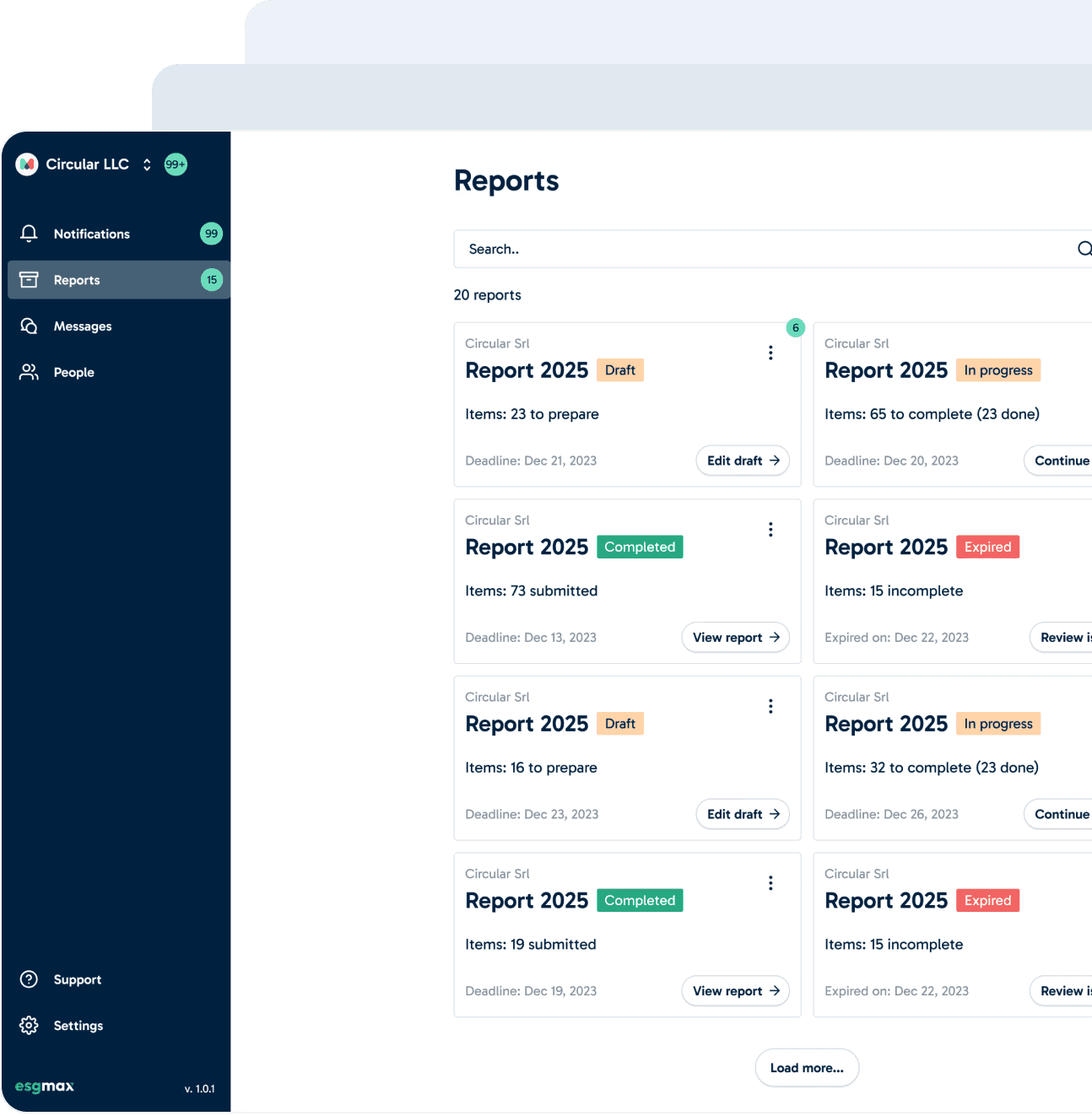
Delivered a complete MVP design for an ESG reporting platform, repositioning Sinapto from a generic project management tool to a differentiated product for project-based businesses. The design includes a full platform UI with budgeting, monitoring, tracking, and reporting capabilities, a carbon accounting dashboard with accessible data visualization, and a shared design system ready for development.
Process
Product strategy and value proposition
We analyzed how the platform could position itself in the market. We looked at major project management tools — Monday, Wrike, Asana, ClickUp, Teamwork — and found that competing on feature parity was not realistic. The value was in ESG/ISG reporting, where few competitors existed. We defined different user profiles (CEO, CFO, Admin, Operations Manager, Account Manager) and created three value propositions. Together with the client, we agreed to focus on C-level and admin profiles, positioning the platform as a reporting tool for project-based businesses rather than a general PM tool.
MVP scoping and roadmap
We applied user story mapping, starting from high-level stories and cutting down to define the MVP. The focus areas: budgeting, monitoring and tracking, reporting, and integrations. We defined a roadmap in three phases: style (visual identity), design platform, and a third phase for defining carbon accounting metrics together with the client.
Visual identity and design system
We designed the product logo and defined a modern color palette with clean typography, then tested how these worked on components. This enabled us to configure a design system shared with the client.
Layout concept and UI design
We proposed two navigation concepts: top navigation (to maximize page space) and a sidebar. The client chose the sidebar. We then designed through wireframes, validated them with the client, and applied the design on top. The design system and components were shared with the client.
Carbon accounting dashboard
We worked with the client's supplier who handles environmental metrics. Together we mapped how CO2 emissions are calculated: by project type, number of people, whether employees work from home or office, commuting patterns, and expense reports. All these variables were integrated into the platform's company configuration. Through workshops, we defined must-have, nice-to-have, and not-needed-now information for the dashboard. We designed custom widgets and defined accessible color palettes (categorical, monochromatic, diverging).
:quality(82)/case-studies/sinapto/iCPYzDw7fkhxd0TtkaCDOpo8Z3s.png)
:quality(82)/case-studies/sinapto/Wr7zC0a7WuJPlfLEqWY71XLwJA.png)
Design assets
The project deliverables included:
— Product logo
— Modern color palette and typography
— Design system with component library (shared with client)
— Wireframes
— Full UI design for the platform
— Carbon accounting dashboard with data visualization
— Accessible color palettes (categorical, monochromatic, diverging)
:quality(82)/case-studies/sinapto/JjEorHPg0dkEskO2QEcRyTPkvo.png)
:quality(82)/case-studies/sinapto/sqJVNjOvMywARuSwREUnDb44Tw.png)
:quality(82)/case-studies/sinapto/oezjCLfr4nMDL6TmQ869qKDPTwc.png)
Challenges
Broad scope with unclear strategy
The initial product vision spanned project management, analytics, and environmental accounting with no clear prioritization or target user.
Complex carbon accounting metrics
Many variables to integrate: project type, team size, remote vs. office work, commuting, expenses. This was not easy work.
Dated existing design
The existing platform had a dated design that needed a complete overhaul.
:quality(82)/case-studies/sinapto/2Zl4qaxaLEqaf8YQFWiCuFXR5U0.png)
Solution
Repositioning through market analysis
Competitive analysis showed ESG/ISG reporting was the differentiating angle. Shifted from "project management tool" to "reporting tool for project-based businesses."
Profile-based MVP scoping
Three value propositions tied to user profiles. Selected C-level and admin as the target, which defined the feature set to cut.
Collaborative dashboard workshops
Workshops with the client to prioritize dashboard information into must-have, nice-to-have, and not-needed categories.
:quality(82)/case-studies/sinapto/A4isAusE4dNkjpDAHEbQ9OcMU.png)
Before & After
A side-by-side look at how Sinapto's platform evolved, from the dated interface to the focused ESG reporting MVP.
:quality(82)/case-studies/sinapto/sxLcZV09zeitG4mGoMu3mTF8AA.png)
Is your product vision too broad to build?
We help you make the sharp decisions that turn it into a focused MVP.
More Case Studies